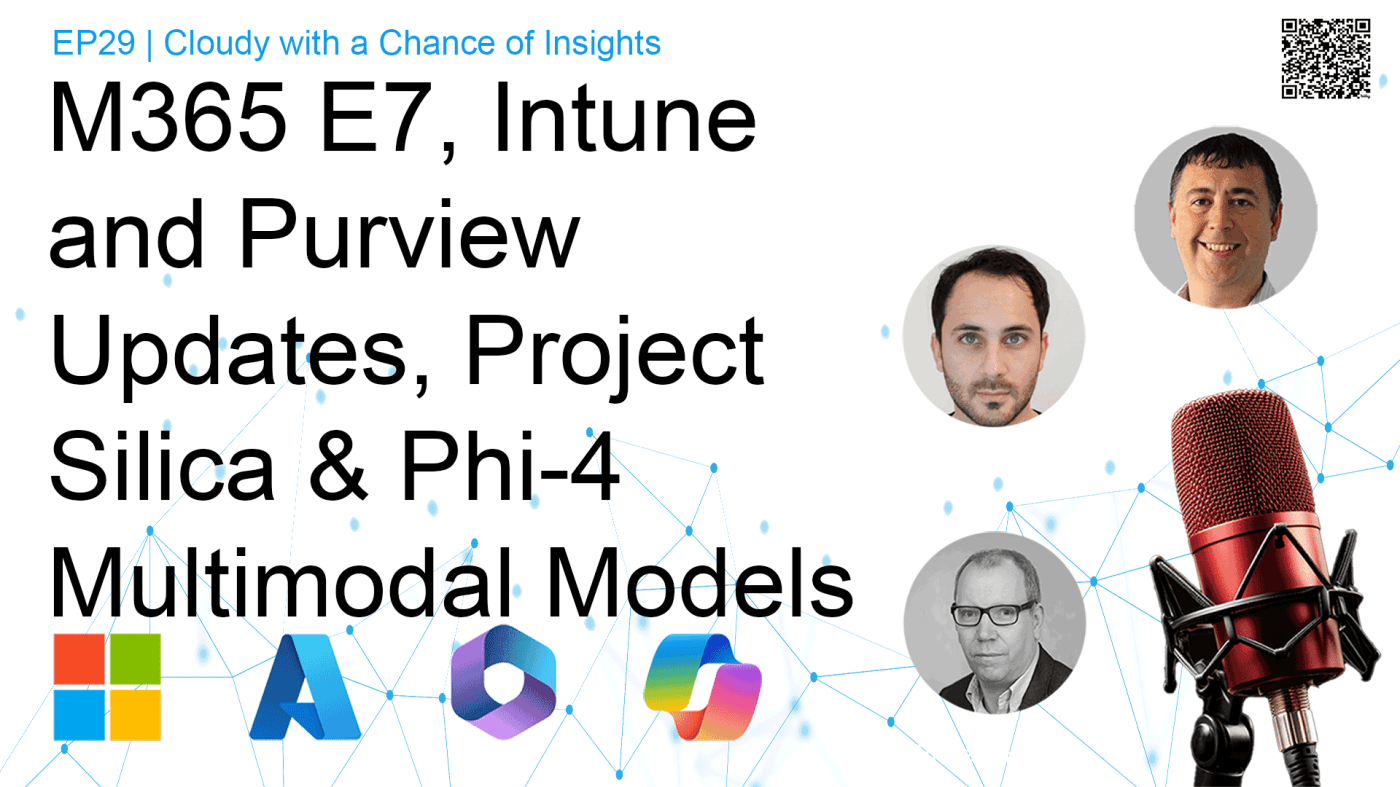
Every so often we record an episode where nothing sounds particularly dramatic, but everything feels important.
This was one of those.
On paper, this episode should not really work. We moved from rumours of a potential Microsoft E7 licence, to AI coding agents fixing bugs, to small reasoning models from Microsoft Research, to storing data inside glass for thousands of years, and finally into why the browser is rapidly becoming more important than the device underneath it.
None of those topics naturally belong together.
And yet, once you step back a little, they all point in the same direction. A shift away from big, obvious announcements and towards quieter, more structural changes in how enterprise technology actually works.
The E7 question and Microsoft’s growing comfort with not owning the model
We opened with something that has been doing the rounds for a while now, the idea that Microsoft may introduce an E7 licence.
At the moment it is still well informed speculation rather than anything official, but the logic behind it is sound. Microsoft keeps releasing new capabilities, agents, Copilot features, Work IQ, security analytics, and consumption based services, and the current licensing story is starting to feel fragmented.
Bundling those capabilities into a single, premium licence feels inevitable.
What was more interesting to me was not the price point chatter, but what this says about Microsoft’s broader strategy. There is a growing acceptance that Microsoft does not need to own the frontier model to win. Instead, it is becoming comfortable orchestrating multiple models, large and small, and focusing on how those models are applied across productivity, security, and operations.
That is a subtle but important shift. It also explains why small, specialised models are starting to get more attention.
AI coding tools and the awkward question nobody likes answering
One of the strongest threads in the episode came from a Microsoft Research paper looking at how AI might change software engineering as a profession.
We have talked about this before on the podcast, but it is starting to feel more real now.
AI coding tools are very good at the tasks that junior engineers traditionally used to learn on. Fixing bugs, writing boilerplate code, adding tests, improving documentation. Those tasks were not glamorous, but they were how people learned how systems actually behaved in production.
Today, I can write a well structured prompt, point an agent at a backlog, and come back half an hour later to something that would previously have been a junior developer’s afternoon. That is genuinely useful for experienced engineers. It removes friction and lets us focus on architecture, integration, and design.
The uncomfortable question is what happens to the learning pathway when those tasks disappear.
If organisations hire fewer junior engineers because AI tools increase senior productivity, where do the next generation of senior engineers come from. It is not a problem we need to solve today, but it is one we should at least be honest about.
Small models, real reasoning, and why not everything needs to be massive
That conversation naturally led into Microsoft Research’s work on small reasoning models, particularly multimodal models designed to reason over images, diagrams, and structured visuals.
As an architect, this is the stuff I find genuinely exciting.
Large language models are impressive, but they are expensive, hard to deploy, and often bad at understanding what they have just generated visually. Anyone who has tried to get an AI to produce a usable PowerPoint slide knows exactly what I mean.
Smaller, specialised models that can run locally, reason over diagrams, and understand visual structure open up far more practical use cases. Offline analysis, secure environments, medical imaging, architectural design reviews. This feels like progress that actually shows up in real work, not just demos.
Project Silica and the long view of data
Then we took a hard left turn into Project Silica.
Microsoft Research has been exploring how to store data inside glass using femtosecond lasers, creating microscopic structures that can be read optically later. The goal is not operational storage, but deep archival storage measured in thousands of years.
It sounds like science fiction until you realise it has been quietly progressing for years.
This is not about replacing disks or tape. It is about cultural archives, legal records, scientific data, and the uncomfortable reality that much of our digital history may not survive the technologies that created it.
It is a reminder that not all innovation is about speed. Some of it is about durability.
Purview, Entra, and the browser quietly taking over
We closed with something much more operational, but arguably more impactful day to day.
There is a clear shift away from device centric security towards browser and identity centric security. Edge for Business, Intune app protection policies, Purview DLP inside the browser, and Entra driven risk remediation all point in the same direction.
Most work now happens in a browser. The device is often just a container.
That changes how we think about unmanaged devices, contractors, partners, and even licensing strategies. It also exposes some ongoing frustrations, Purview still has too many control planes, too many PowerShell only capabilities, and not enough clean APIs.
But the direction of travel is clear. Identity, data, and browser context matter more than the hardware you happen to be using.
Nothing dramatic, everything important
This episode did not have a single headline grabbing announcement.
Instead, it was a collection of small signals that, taken together, suggest we are moving into a different phase of enterprise IT. Less obsession with single models or single devices, more focus on orchestration, specialisation, and long term thinking.
Those shifts are quieter. They do not always make good keynotes.
But they are the ones that tend to matter.
If that sounds like your kind of conversation, the episode is now live.
YouTube: https://youtu.be/F054yF45tRg
Spotify: https://open.spotify.com/episode/3vzgJEcP4VkfAhIvU5VsVc?si=533bdeaa366e436b
 The Microsoft Cloud Blog
Leave a comment