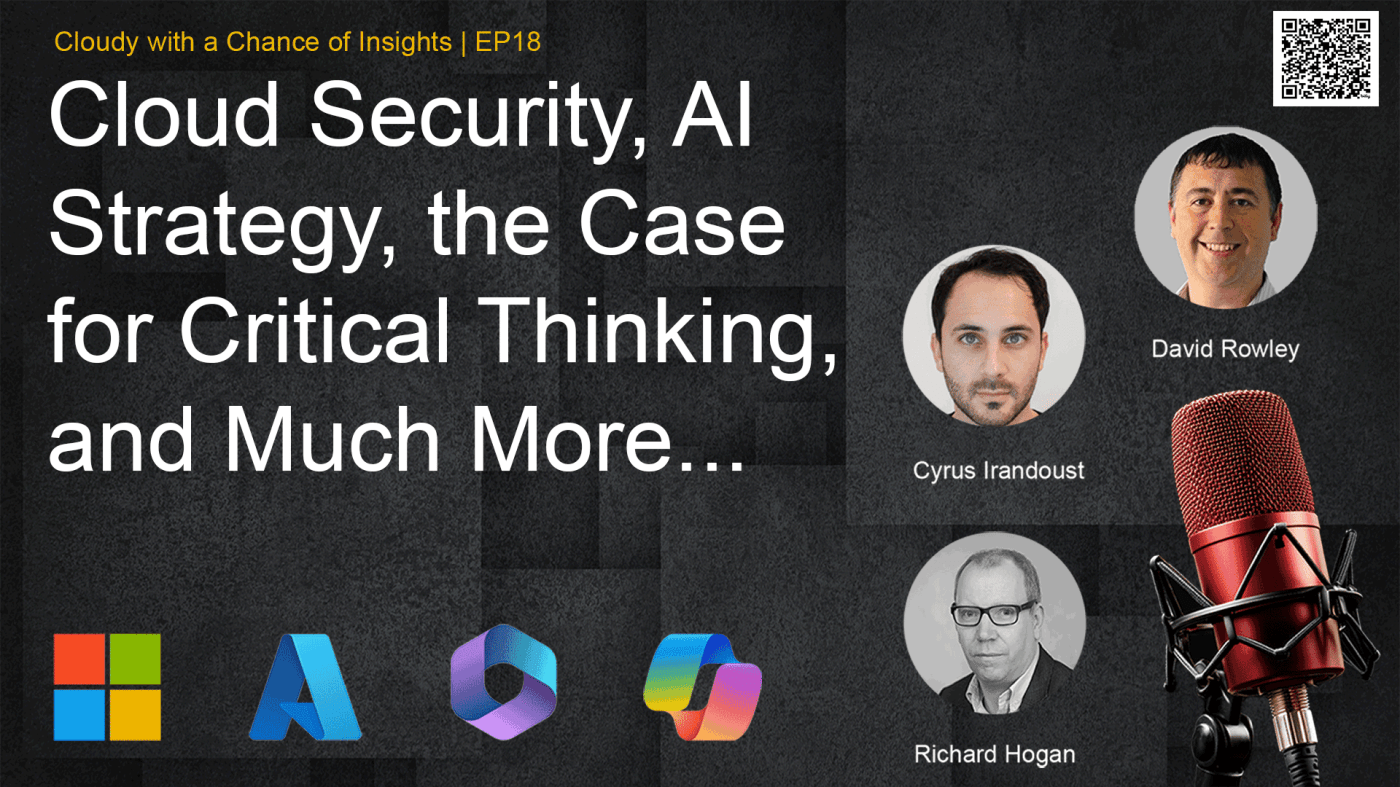
It’s August, and while the Microsoft Cloud news cycle tends to slow down this time of year, the latest episode of Cloudy with a Chance of Insights proved that there’s still plenty to talk about. David, Cyrus, and I dove into a mix of technical updates, strategic pivots, and philosophical tangents—all centered around the evolving Microsoft Cloud landscape.
Rethinking the Perimeter
David kicked things off with a look at the Azure Network Security Perimeter, a shift from traditional network-centric security to resource-level protection. Instead of securing the whole network, you now secure individual resources—databases, storage accounts, app services—wherever they run. It’s modular, it’s flexible, and it’s a departure from the “Azure as a third data center” mindset that many organizations still cling to.
We’ve all seen cloud migrations that mimic legacy data center architectures. The problem? That approach often leads to inefficiencies, repatriation, and missed opportunities. Treating cloud as its own architectural paradigm—not just an extension of the past—is critical. And this new perimeter model feels like a step in the right direction.
Linux Gets Guardrails
Next up: Linux OS Guard. Microsoft’s investment in Linux security is quietly becoming one of the most important stories in Azure. With features like verified trust at the OS and container level, secure boot, and VTPM-backed launch, Linux workloads are getting the same hardened treatment as Windows.
Given that a majority of Azure workloads now run on Linux, this isn’t optional—it’s essential. Cyrus pointed out that the perception of Azure as “just Windows” is outdated, and I couldn’t agree more. Microsoft is clearly working to elevate Linux as a first-class citizen in its cloud ecosystem.
Mission Reframed: AI and Security
We also unpacked Satya Nadella’s recent blog post, which reframes Microsoft’s mission around three pillars: empowering people, building platforms, and leading with AI and security. While the “why” remains the same, the “what” and “how” are shifting dramatically.
The AI-first strategy is bold—but it’s also risky. As David noted, if the AI bubble pops, what’s left? The investments in Copilot, GPT-5, and frontier firm models are massive. If they don’t deliver, Microsoft (and many others) will need to pivot hard. That’s why the second pillar—security—is so important. It’s the safety net, the foundation, and increasingly, the differentiator.
Terraform’s Microsoft Moment
Cyrus brought the heat with two updates that didn’t get nearly enough attention:
- Microsoft Graph Terraform Provider (Public Preview)
This is a big deal. It replaces the Azure AD provider and introduces zero-day support for Graph API changes. That means you can manage Microsoft 365, Entra, and more with Terraform—securely, scalably, and without waiting for community updates. - Terraform VS Code Extension
Rebranded and refreshed, this write-only extension offers IntelliSense, best-practice scaffolding, and support for Graph API. It’s not Copilot-smart, but it’s a solid productivity booster—especially for greenfield deployments.
Together, these updates signal a deeper commitment to Terraform and multi-cloud tooling. For those of us who’ve wrestled with Bicep vs. Terraform debates, this feels like a turning point.
Secure Futures, Now Public
I wrapped up the episode with a look at the Secure Futures Initiative (SFI). Originally an internal Microsoft effort, SFI is now surfacing public-facing patterns and practices for cloud security. These aren’t just for CISOs—they’re for anyone deploying workloads in Azure.
From conditional access to data protection and identity-first design, the new SFI guidance is practical, actionable, and worth exploring. I’ll drop the link in the show notes, but if you’re building in Azure, this should be on your radar.
The Case for Critical Thinking
Finally, we touched on something that’s becoming increasingly important: critical thinking in the age of AI. Whether it’s GPT-5 giving medical advice or Copilot going off-script, users need to be discerning. AI is powerful, but it’s not infallible. And as Cyrus reminded us, cultural differences in how we respond to AI-generated content—especially in high-stakes scenarios—matter.
We joked about Darwin Awards and glue-on-pizza stories, but the underlying message is serious: don’t outsource your judgment to a model.
Final Thoughts
This episode felt like a microcosm of where the Microsoft Cloud is headed: modular security, Linux parity, AI ambition, and a renewed focus on governance and tooling. It’s a lot to digest, but it’s also exciting.
If you haven’t listened yet, you can catch the full episode (links below) And if you have thoughts, feedback, or tangents of your own, drop us a comment—we read every one.
YouTube: https://youtu.be/MCQU6rDjENA
Spotify: https://open.spotify.com/episode/1b4qJSpfyCcTfqdFnw8wv1?si=50dcedc9b7fc490e
Apple: https://podcasts.apple.com/gb/podcast/cloudy-with-a-chance-of-insights/id1783369178?i=1000723399968
 The Microsoft Cloud Blog
Leave a comment